The island's history
Even leaving hurricanes aside, the island's history has been anything but storm-free. Ancient relics suggest that its first brave settlers, around 3500 years ago, were probably the Ciboney Indians, a subgroup of the Arawaks.
Later, another group of Arawaks arrived from South America's Orinoco Basin, around 800 AD. Thanks to St. Martin's salt pond, which still exists today, they named the island "Soualiga", or "Land of Salt". As was typical of the time, they lived mainly by farming and fishing. Their thatched-roof buildings were, according to historians, sturdy enough to withstand hurricanes. Anyone who's ever seen a hurricane, or even just its aftermath, knows that's out of the question...
They built a peaceful civilization with a simple artistic and spiritual culture.
But their lives were turned upside down when the Carib Indians arrived from the same region (their name is the same as that of a popular beer you can still buy on the island...). The Caribs were a warrior nation, and, as was their custom, they killed the Arawak men and enslaved the women. By the time Europeans discovered the Caribbean, Carib society had almost completely displaced the Arawaks.
The real trouble, of course, began when the Europeans arrived...
On 1493 November 11, St. Martin's Day, Columbus (the first adventure traveller) spotted the island on his second voyage and, understandably, named it Isla de San Martín after Saint Martin of Tours. But although he claimed it as Spanish territory, Columbus never set foot on the island, and Spain considered settling it unimportant and uneconomical. Just think: tourism wasn't yet a major industry back then.
The French and the Dutch, on the other hand, already had their eyes on the island. The French wanted to colonize the islands between Trinidad and Bermuda, while Saint Martin offered the Dutch a convenient halfway point between their colonies of New Amsterdam (present-day New York) and Brazil.
The island had few inhabitants, so the Dutch established a settlement without resistance in 1631. They built a fort called Fort Amsterdam to defend against invasions. Jan Claeszen Van Campen was the first governor, and soon the Dutch West India Company also began extracting salt.
French and British settlements also sprang up on the island. Seeing the successful colonies and the economic benefits of the salt trade, the Spanish now found the place more appealing. The Spanish–Dutch War, raging between mainland Spain and the Netherlands, gave them an additional incentive to attack.
In 1633, Spanish forces seized the island from the Dutch, taking control of the territory and driving out most or all of the settlers. At Point Blanche, they built the Old Spanish Fort to secure the territory. Although the Dutch made several attempts to retake the island, they didn't succeed. 15 years after the island was seized, in 1633, the Spanish–Dutch War ended. With no further need for a base in the Caribbean and the island bringing in little economic profit, the Spanish lost interest in defending it. In 1648, they left the island again.
Saint Martin was free again, and both the Dutch and the French took the opportunity to resettle. You couldn't ask for a better example of the old saying that "history repeats itself". The Dutch settlers came from St. Eustatius, and the French from St. Kitts. After some initial conflict, both sides realized that neither would give in easily. To avoid all-out war, they signed the Treaty of Concordia in 1648, dividing the island. The treaty was signed by the island's two governors, Robert de Longvilliers for France and Martin Thomas for the Dutch Republic. The French kept the northern territory they occupied and the coast facing Anguilla, while the Dutch got the town and surrounding areas on the southern coast. The inhabitants could share the island's natural resources.
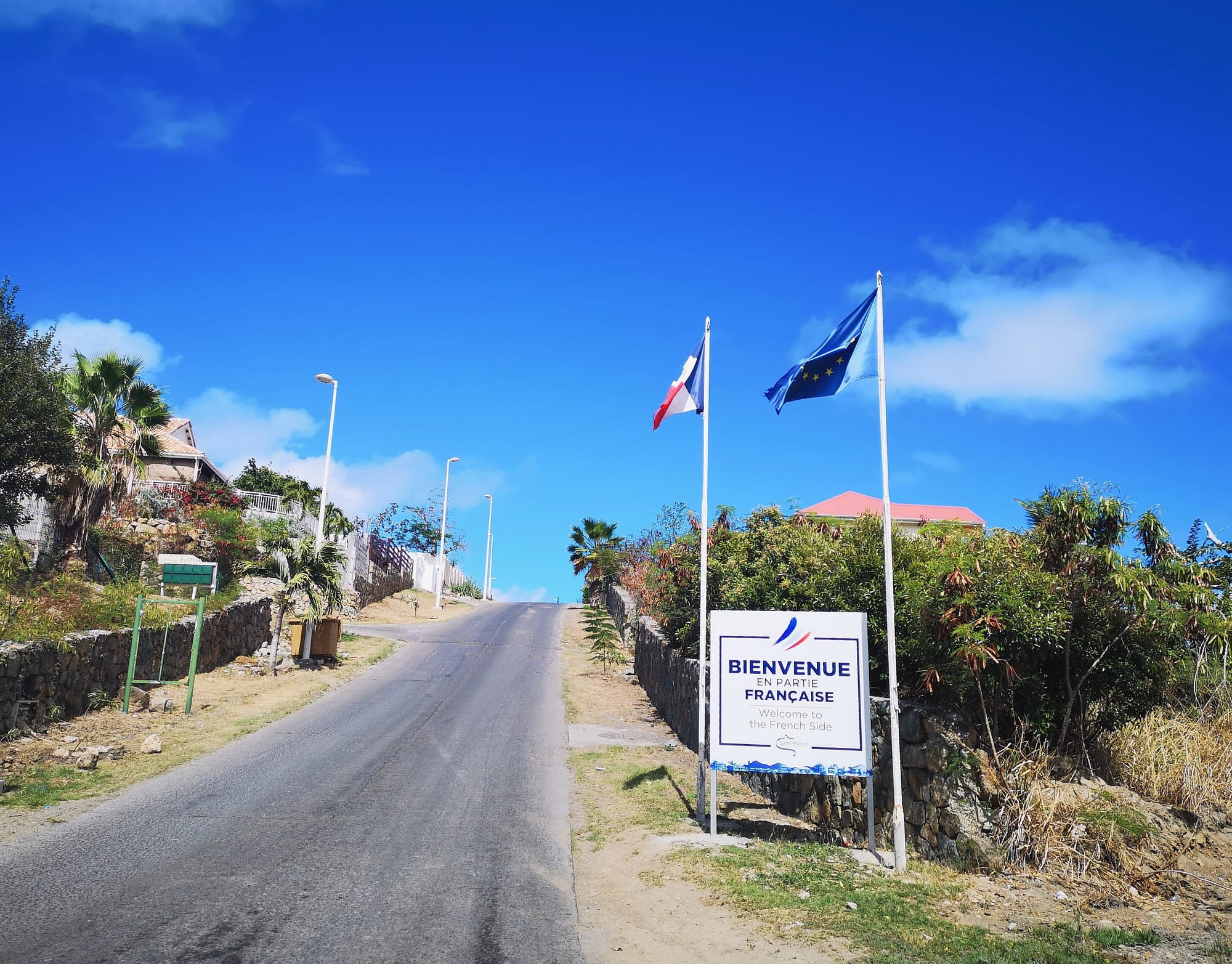
A legend grew up around the division of the island. According to the story, the two sides held a contest to decide their territorial boundaries. A French gentleman drank wine, while a Dutch gentleman drank jenever (Dutch spirits). Once they'd both had enough to drink, they set off from Oysterpond on the island's eastern coast. The Frenchman followed the northern coast, while the Dutchman followed the southern coast. Wherever the two gentlemen met, that's where the border would be drawn. But the Dutchman met a lady and stopped to sleep off the tiredness brought on by the spirits, so the Frenchman was able to cover more ground. According to the legend, though, the Frenchman also apparently cheated by cutting across the northeastern part of the island, gaining more land for his country. The legend further accuses the Frenchman of occasionally running instead of walking like a gentleman, despite their agreement.
Though it's still often told today, the story isn't based on historical fact. During the treaty negotiations, the French had a substantial fleet off the coast, which they used as a threat.
Despite the treaty establishing the borders, relations between the two sides weren't always friendly. Between 1648 and 1816, conflicts changed the border sixteen times. In the end, the French came out ahead with 21 square miles (54 km2), compared with 16 square miles (41 km2) on the Dutch side.
In 1651, the Compagnie des Îles de l'Amérique sold the French part of the island to the Knights of St. John of Malta. After the order had ruled for 14 years, it was returned to the French West India Company in 1665, along with the order's other Caribbean possessions.
Although the Spanish initially brought only a small number of enslaved people to the island, the promise of high profits from growing cotton, tobacco and sugar cane later led to enslaved people being brought in large numbers to work on the estates. The dark-skinned enslaved population quickly outnumbered the white landowners. As was customary at the time, enslaved people were subjected to cruel treatment. Understandably, they organized rebellions and, because they greatly outnumbered the landowners, were able to achieve some success. In 1848, the French abolished slavery in their colonies, including the French side of St. Martin. The decision prompted enslaved people on the Dutch side to protest and threaten to flee to the French side. The Dutch authorities gave in and emancipated the enslaved people in the colonies. Although this decree was respected locally, enslaved people only became legally free in 1863, when the Dutch abolished slavery in all their island colonies.
The island remains divided between two states to this day, but nowadays the conflicts have practically disappeared. The French, the Dutch and the local population of people of colour descended from formerly enslaved people live peacefully side by side.
After slavery was abolished, the plantation economy declined, and the island's economy suffered. In 1939, St. Martin received a major boost when it was declared a duty-free port. The Dutch began focusing on tourism in the 1950s. It took the French another twenty years to start developing their tourism industry. Today, tourism is the backbone of the economy on both sides of the island.
Hurricanes Luis and Donna caused considerable damage to the island in the XX century, but each time the infrastructure and economy recovered.
In 1994, the Kingdom of the Netherlands and France signed the Franco-Dutch treaty on Saint Martin's border controls, allowing joint French-Dutch border checks on "risky flights". After some delay, the treaty was also ratified in the Netherlands in 2006. November and then came into force on 2007. August 1. Although the treaty is now in force, its provisions haven't yet been implemented because the working group specified in the treaty hasn't been established. After all, rushing around isn't really the Caribbean way.
On 2017 September 6, Hurricane Irma - a category 5+ storm - virtually destroyed the island with sustained winds of over 180 MPH. The Netherlands and France established various funds to help restore the island's economy. The Dutch provided a 550 million euro fund, managed by a recovery planning office, also known as the NRPB.
Sadly, assistance from the French side was much slower and less effective, but fortunately, life has now almost completely returned to normal. And through it all, the island hasn't forgotten how to be the Friendly Island.